




Camp Pendleton Base Access: What to Bring and Expect
A corporate group’s Camp Pendleton access checklist: physical ID, advance roster, coach and driver details, gate arrival, and exceptions.

For a corporate event at Camp Pendleton, each attendee needs the physical identification specified for the confirmed programme, and the organizer must complete the advance access process. At the gate, the installation checks identity and authorization. An event booking by itself does not grant entry.
Start with your programme coordinator’s current roster and arrival instructions. Camp Pendleton sets the rules and can change them; an individual visitor route may not apply to a chartered corporate group.
The practical sequence is to confirm the group and access owner, submit the required information securely, resolve special cases early, align the coach manifest, and brief participants on documents and meeting time.
Quick answer: Bring the valid physical ID and any printed approval specified by your event coordinator. The organizer must submit the roster by the event-specific deadline and confirm the coach and driver’s access plan. At the gate, follow the assigned route and checkpoint instructions. Entry remains the installation’s decision; check the official Base Access page again before travel.
Table of contents
- Can a corporate group get onto Camp Pendleton?
- Why corporate-group access is different from an individual visit
- The corporate group-access workflow
- Collect participant information without creating a privacy problem
- What to bring: accepted ID and event documents
- Virtual and in-person visitor processing in 2026
- Foreign nationals and permanent residents need an earlier conversation
- Coach transport is part of the access plan
- What happens at the gate and on event day?
- Problems that derail group access
- Who is responsible for what?
- The final 72-hour checklist
Can a corporate group get onto Camp Pendleton?
Yes—when the visit has an authorized purpose, the applicable sponsorship or coordination is in place, required screening is completed and each participant presents acceptable identification.
The official Camp Pendleton Base Access page says access requirements vary by purpose and sponsorship status. It describes several routes for individual visitors, contractors, transportation providers, foreign nationals and command-sponsored events. A private corporate programme is not automatically interchangeable with any one of those categories.
That distinction matters. The public guidance explains the installation’s rules; the Experience Camp Pendleton coordinator explains how the confirmed programme will comply with the route currently applicable to that event. Participants should not self-select a process from a search result unless instructed.
The safest answer for an HR or event lead is therefore:
- Confirm the programme and likely headcount early.
- Make citizenship, identification and transport questions visible before contracts and flights become difficult to change.
- Follow the coordinator’s roster and document instructions exactly.
- Recheck official guidance close to the event.
- Carry a fallback for anyone who is not cleared or does not bring the required identification.
Access can be arranged commercially, but it cannot be guaranteed by marketing copy. The installation retains the decision.
Why corporate-group access is different from an individual visit
An individual may be visiting family, reporting for work, attending a military ceremony, using an authorized service or entering with a credential they already hold. Each purpose has its own rules.
A corporate programme creates additional operational questions:
- Dozens of names may need to be checked against one event record.
- The group may include several citizenship or residency statuses.
- The person buying the event is not necessarily an authorized installation sponsor.
- A charter vehicle and driver need an access plan as well as the passengers.
- The agenda depends on the group arriving together.
- Personal information must move between the participant, employer, coordinator and authorized process without becoming a widely shared planning file.
That is why a group process should be designed backwards from the installation’s current deadline, not forwards from the departure email.
| Situation | Likely route | Organizer’s first action |
|---|---|---|
| Experience Camp Pendleton corporate programme | Event-specific advance coordination | Follow the programme coordinator’s roster instructions |
| Eligible U.S.-citizen social visitor | Sponsor-led virtual or in-person process | Confirm sponsor eligibility and current official steps |
| Visitor without virtual processing | Visitor Center process | Allow substantial processing time and bring accepted ID |
| Foreign national | Separate advance review and escort rules | Disclose status early and request current guidance |
| Contractor or vendor performing work | Contractor/vendor process | Use the official work-related access route |
| Driver or transport provider | Transportation-provider rules | Verify both company and driver access before event day |
This table is a planning map, not a determination of eligibility. Camp Pendleton assigns and controls the actual route.
The corporate group-access workflow
For the full Semper Fi programme, the live client guidance says the roster is cleared in advance, the installation sets the deadline and base coordination is included. It also uses coordinated group transport and allows time at the security checkpoint.

The practical workflow has seven stages.
1. Confirm the event shape and access owner
Choose the date range, likely headcount and Experience Camp Pendleton package. Name one person at the client organization who owns the roster and one backup who can act when that person is unavailable.
The roster owner should be able to reach participants privately and make a fast decision about late additions. They should not delegate the final reconciliation to a general events inbox.
2. Segment the likely attendee list
Before collecting documents, ask the coordinator which status categories matter for the event. At minimum, identify potential foreign nationals, permanent residents, people who already hold a valid base-access credential and anyone unsure whether their identification meets the current standard.
Do not infer citizenship from a person’s name, accent or work location. Ask the narrow question the access process requires, explain why and provide a private response route.
3. Receive the current deadline and required fields
The installation sets the deadline, and the applicable lead time can change. Build the company’s internal deadline earlier than the official submission deadline so there is time to correct names, unclear documents and late responses.
If the coordinator needs the final file on a Monday, an internal Friday deadline is not a buffer. Make it the prior Wednesday and plan two reminders.
4. Collect the minimum required information securely
Use the approved collection and transfer method. Restrict access to the roster owner, backup and people who must process it. Do not place passport copies, birth certificates, Social Security cards or other sensitive documents in an open project channel.
Match every legal name to the identification the participant will carry. A preferred name can still appear on the event badge; the access record needs the identity the installation can verify.
5. Resolve exceptions before final submission
Flag foreign nationals, name changes, non-REAL-ID licences, missing documents, transport drivers and uncertain status early. Do not quietly leave a person off the submission while hoping the gate team can fix it.
If someone joins after the deadline, ask the coordinator what is possible. The answer may be no. A clear answer before travel is better than a failed arrival in front of colleagues.
6. Reconcile the roster, coach manifest and catering count
These lists are often owned by different people and rarely remain identical without a deliberate check. Compare them line by line. Confirm that every expected passenger appears on the current access file and that removed attendees are not still driving meal or transport costs.
Keep a version date on operational lists. “Final roster” is not a useful filename when four versions are circulating.
7. Brief the group once, clearly
Send one definitive arrival message that covers:
- Where and when the group meets.
- Which identification each person must physically carry.
- Whether any approved pass or document must be printed.
- What not to bring or photograph, if instructed.
- Coach boarding and luggage rules.
- The late-arrival procedure.
- The private contact for a last-minute identification or access concern.
Avoid forwarding raw official instructions without explaining which parts apply to this programme. Participants need one current action list, not a research project.
Collect participant information without creating a privacy problem
Access planning can involve identity, citizenship or residency information. Treat it as a controlled operational dataset, not normal event trivia.
Use five rules:
1. Purpose: state exactly why the information is needed.
2. Minimum: collect only the fields and documents requested for the current process.
3. Access: limit the file to named people with an operational need.
4. Transfer: use the method approved by the coordinator or installation process.
5. Retention: decide when local copies and exports will be deleted after the event.
The event team should not collect criminal-history explanations or attempt to predict the result of a background check. The installation performs its process and makes the decision. If an attendee has a concern, route it privately to the coordinator or official access contact rather than inviting disclosure to a manager.
Separate the event badge list from the access roster. The badge file may contain a preferred name, title and dietary code. The access record may require a legal name and other controlled fields. Combining every detail into one master spreadsheet increases exposure and confusion.
What to bring: accepted ID and event documents
Each participant should carry the original, unexpired physical ID that matches the access record. Bring an approved printed pass when the coordinator says one is required. Keep it with the participant, not in a checked bag or the organizer’s folder.
The current Acceptable Credentials for Visitors sheet lists four options. Documents must be valid and unexpired.
| Option | What the visitor brings | Important detail |
|---|---|---|
| REAL ID licence | REAL ID-compliant driver’s licence | Must be valid and unexpired |
| Enhanced licence | Enhanced driver’s licence | Issued only by certain states |
| Passport | U.S. passport or passport card | Must be valid and unexpired |
| Document combination | Birth certificate + Social Security card + non-REAL-ID licence | Names must match or be supported by name-change records |
The official sheet says the birth certificate in the combination must be an original or certified true copy bearing a raised seal. All three documents must carry the same name or a former name supported by acceptable name-change documentation.
A standard driver’s licence marked “Federal Limits Apply,” “Not Valid for Federal Purposes” or similar should not be treated as enough by itself. Do not rely on a photograph or digital wallet version unless current event instructions explicitly allow it.
This summary does not replace the official credential sheet. Link participants to the current source and ask the coordinator about any document that does not fit cleanly into one option.
Virtual and in-person visitor processing in 2026
The official page currently describes a streamlined virtual visitor process for eligible U.S. citizens whose authorized sponsor has the specified military network access, email and government identification. The visitor pre-enrolls in DBIDS, gives the confirmation code, identification information and a recent front-facing photograph to the sponsor, and the sponsor submits the official request.
As checked on September 23, 2026, the official Base Access page says an eligible sponsor’s virtual request must be submitted at least five days before arrival. Approved passes are emailed to the sponsor for printing; a phone copy is not accepted. This individual visitor route is not a self-service registration process for a corporate group.
Visitors who do not use the virtual route may be processed in person at the Visitor Center. The current official guidance says this includes acceptable identification, a photograph, fingerprinting and a background check. It also warns that peak-period waits can be approximately two to four hours.
That wait is one reason an event lead should not treat the Visitor Center as the normal morning check-in desk for a coach group. If in-person processing applies to someone, it should be identified and scheduled according to current guidance rather than discovered at the event’s start time.
Official hours and procedures can change. The Base Access page is the source to check, not an old screenshot or a colleague’s memory from a previous visit.
Foreign nationals and permanent residents need an earlier conversation
Tell the Experience Camp Pendleton coordinator about potential foreign-national attendees as soon as the group is being shaped. Do not wait for the final roster.
The official page says foreign nationals do not use the U.S.-citizen virtual visitor route and require separate processing. It describes advance notification, screening, in-person credential issuance and escort requirements. The exact route also differs between official visitors, personal visitors, contractors and other purposes.
Permanent residents are treated as U.S. persons for part of the official screening framework, but the current page still describes a DBIDS credential with restrictions and an escort. Do not translate “green card holder” into “same process as a U.S. citizen” without confirmation.
For a mixed-nationality company, three planning choices help:
- Collect status early through a private channel.
- Keep the programme flexible until the applicable route and lead time are confirmed.
- Avoid non-refundable individual travel for uncertain attendees until the access path is understood.
An international employee should not be surprised by a special process in a group email. Handle the conversation directly, explain that the installation sets the requirement and avoid framing the person as a problem for the event.
Coach transport is part of the access plan
The people, vehicle and driver each need a viable arrival plan. A charter company that can reach a San Diego hotel is not automatically prepared to operate on Camp Pendleton.
The official Base Access page has a separate section for transportation providers. It says drivers may need a current base credential or temporary processing depending on status and conditions. It also publishes which providers are currently approved to operate aboard the installation and warns base personnel to verify that a pickup driver can enter.
For the Semper Fi sample itinerary, the client site specifies a coordinated group vehicle and includes base coordination. Confirm these points in writing:
- Provider and driver details are submitted by the required deadline.
- The assigned driver—not only the transport company—meets the current requirement.
- Vehicle size and passenger count match the programme plan.
- The driver has the correct gate, route, arrival window and coordinator number.
- The replacement-driver process is understood.
- Nobody assumes rideshare pickup will be available in the same way it is downtown.
Group transport also protects the agenda. One coordinated arrival is easier to clear, brief and move than thirty cars reaching different gates.

What happens at the gate and on event day?
At the checkpoint, the driver and event lead follow the confirmed gate and arrival window while participants present the required identification. Anyone needing separate visitor processing must follow the coordinator’s instructions. The gate makes the final entry decision, so leave time in the run of show for checks.
The exact sequence comes from the programme coordinator, but a well-prepared group should expect five stages.
1. Meet before the departure time
The stated meeting time is earlier than the coach movement time. The roster owner confirms people and identification before loading, away from the pressure of the gate.
2. Resolve missing people before the vehicle moves
Do not hold the entire group indefinitely for an attendee who has not answered. Use the late-arrival rule already provided. A person travelling separately may not have the same access plan as the coach.
3. Keep required identification with each participant
Identification belongs with the person, not in checked luggage, the event lead’s bag or a shared envelope. The name should match the submitted access record.
4. Follow the coordinator’s checkpoint instructions
At the checkpoint, participants should remain calm, have documents ready and avoid creating their own explanation of the event. The driver and event lead follow the current instructions. Allow the time included in the run of show.
5. Stay with the programme movement plan
Once aboard, the group follows the authorized itinerary and host guidance. Do not promise independent access to other areas of the installation. Photography, route and venue instructions should be treated as operational requirements, not suggestions.

The full Experience Camp Pendleton day is designed around this coordinated arrival. After the checkpoint, the experience can move through venues, history, hospitality and facilitated team work as one programme rather than a collection of individual visits.

Problems that derail group access
Most preventable failures come from assumptions made earlier.
The name on the roster does not match the identification
Prevent it by collecting the legal name shown on the document. Keep preferred names separately for badges and hospitality.
Someone brings only a non-REAL-ID licence
Send the official credential options before the event and ask uncertain attendees to resolve their document plan early. Do not promise that a photo of another document will be accepted.
A foreign-national attendee appears late in the planning cycle
Escalate immediately. Do not hide the status to protect the schedule. The applicable screening and escort process may require more time than remains.
The transport company changes the driver
Require the provider to notify the operations lead. A qualified company does not make every substitute driver automatically ready for the installation.
An attendee plans to drive separately
Separate arrival can change both the vehicle and sponsorship assumptions. Ask the coordinator before approving it. The coach manifest is not a universal pass for other vehicles.
The team relies on Trusted Traveler
As checked on September 23, 2026, Camp Pendleton lists the Trusted Traveler program as suspended. A corporate arrival should follow its confirmed event access process regardless of any future change to that program.
The roster changes after the deadline
Ask what the current process permits. Do not edit a submitted file and assume the update reached the people controlling entry. Keep an audit trail of what was sent, when and by whom.
Who is responsible for what?
Access works when responsibility is explicit. The company should not attempt to act as the installation, and the programme operator should not promise a decision only the installation can make.
| Party | Owns | Does not control |
|---|---|---|
| Company organizer | Accurate roster, deadlines, secure collection, participant briefing | Installation approval |
| Participant | Truthful information, correct documents, timely arrival | Which access route applies |
| Experience Camp Pendleton | Programme guidance, base coordination, itinerary and client communications | Final installation decision |
| Transport provider | Eligible vehicle/driver, route readiness and substitutions | Passenger eligibility |
| Camp Pendleton | Requirements, screening, credentials, gates and entry decisions | Company travel or attendance policy |
This division should appear in the internal event plan. When an exception emerges, send it to the party that can actually resolve it.
The final 72-hour checklist
Three days before the event, the organizer should be able to answer yes to each item:
- The programme coordinator has confirmed the current arrival instructions.
- The submitted attendee roster matches the expected coach passengers.
- Every participant has been told which physical identification to carry.
- Any required approved pass or instruction has been printed as directed.
- Foreign-national and permanent-resident cases have an explicit plan.
- The transport provider and assigned driver have confirmed access readiness.
- The group knows the meeting time, departure time and late-arrival rule.
- One organizer and one backup can reach the coordinator during travel.
- Sensitive local roster copies have restricted access.
- A plan exists for a person who is denied entry or arrives without the correct document.
That final point is not pessimistic. A respectful fallback protects the individual from being left alone and protects the rest of the group from an improvised decision at the checkpoint.
For the broader event workback, use the eight-week company offsite playbook. For budgeting, see the San Diego corporate retreat cost guide. If you are still comparing formats, start with one-day company retreat ideas and large-group team-building activities.
Experience Camp Pendleton is a commercial service operated by Urban Kitchen Hospitality / Mid Coast Supply Inc. It is not affiliated with, endorsed by or sponsored by the United States Department of Defense, the United States Marine Corps or Marine Corps Community Services. Access to Marine Corps Base Camp Pendleton is controlled by the installation and subject to change at any time. Confirm current requirements at pendleton.marines.mil before travel.
Before you ask
Common questions
Can civilians get a Camp Pendleton visitor pass?
Yes, civilians may receive authorized access when the applicable sponsorship or programme coordination is in place, they present acceptable identification and they pass the installation’s required process. The route depends on the purpose of the visit and the person’s status.
Can a corporate group apply for Camp Pendleton visitor passes online?
Do not treat the public virtual visitor process as a self-service group-registration page. It is sponsor-led and has eligibility conditions. For an Experience Camp Pendleton event, follow the coordinator’s event-specific roster and access instructions rather than asking every attendee to apply independently.
Does everyone need a REAL ID to enter Camp Pendleton?
The current credential sheet lists alternatives to a REAL ID-compliant licence, including an enhanced driver’s licence, a valid U.S. passport or passport card, or a specified combination of a non-REAL-ID licence, Social Security card and qualifying birth certificate. Check the official sheet before travel.
Can foreign-national employees attend a corporate event at Camp Pendleton?
Potentially, but they require a different process and earlier coordination. Tell the programme coordinator as soon as possible. Do not book around an assumed approval or ask the attendee to use the U.S.-citizen virtual route.
Should our group stop at the Camp Pendleton Visitor Center on event morning?
Only if the current event instructions say that someone must use in-person processing. The official page warns that peak-period waits can be two to four hours. A coordinated group programme should identify this need before the day rather than using the Visitor Center as normal group check-in.
Can an attendee drive separately from the company coach?
Do not assume so. A separate driver and vehicle may need a different access plan, and the person may not be covered by the coach arrival process. Ask the Experience Camp Pendleton coordinator before approving independent travel.
How early should a corporate group submit its roster?
Use the deadline supplied for the confirmed programme and set an earlier company deadline to resolve name, ID and transport exceptions. The installation controls the timing and may change it. Confirm the current lead time with the Experience Camp Pendleton coordinator before inviting attendees.
Written by
Rene Diaz
President
Four packages
Bring your
team here.
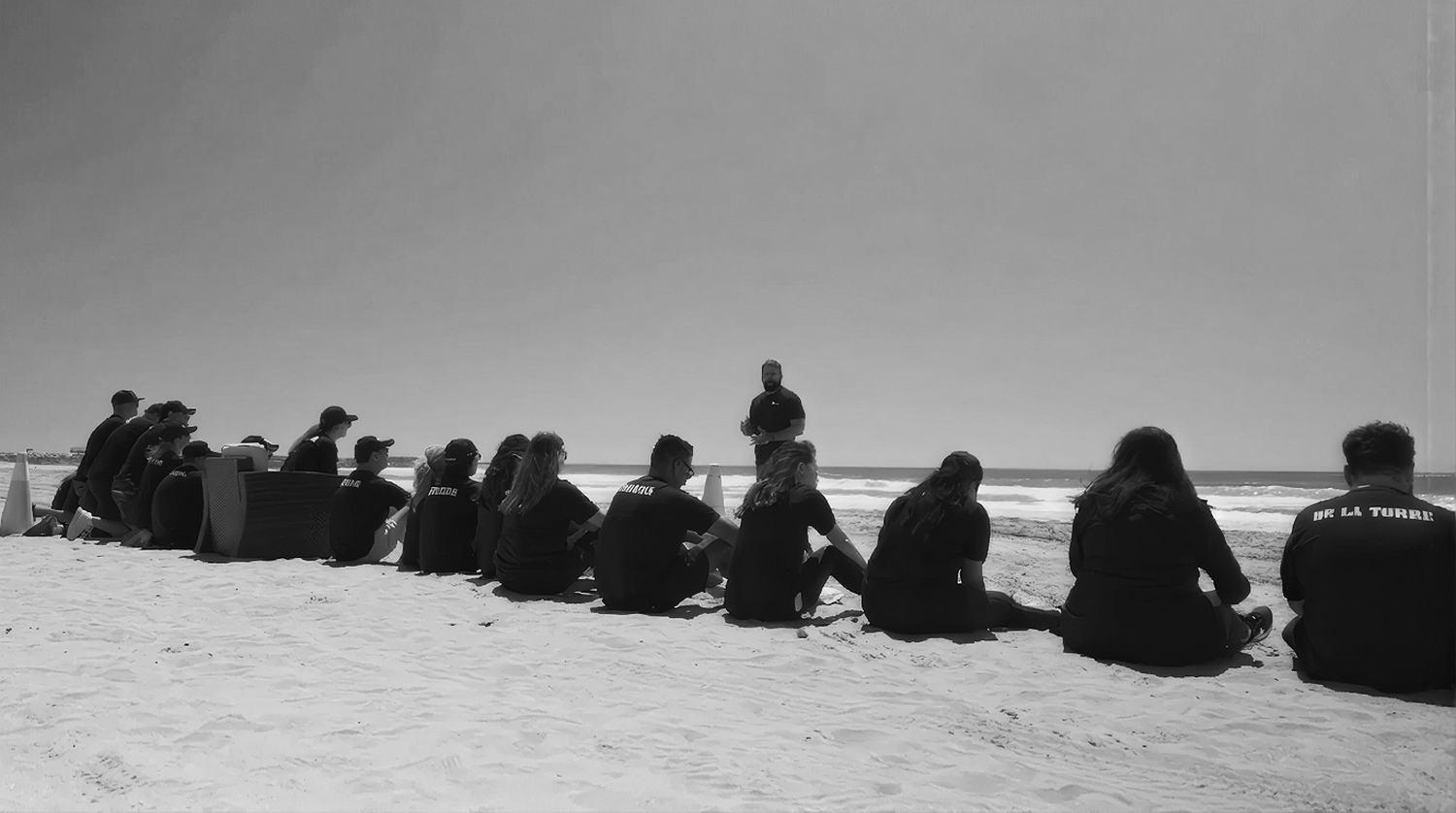
Half a day to a full day, from a history session and lunch to both venues, beach team building and a reception on the deck.