

12 Holiday Team-Building Activities for Work (2026)
Compare 12 holiday team-building activities by outcome, group size, format and planning effort, including office, remote and hosted options.
The best holiday team-building activities give coworkers a useful reason to interact; they do not simply put a seasonal label on a party game. Choose a format that rehearses one behavior your team needs, such as clearer handoffs, broader recognition or calmer decisions, and give people more than one meaningful way to contribute.
For most work teams, a structured activity lasting 45 to 90 minutes is enough. Larger or more distributed groups benefit from parallel pods. A hosted half-day or full-day experience makes sense when the shared experience is the year-end event itself.
TL;DR: Pick one outcome before choosing an activity. Use a scenario challenge for communication, an appreciation map for recognition, a partner-led service sprint for shared purpose, or a hosted offsite for a deeper reset. Keep participation culturally neutral and physically flexible, explain what is optional, and finish with a ten-minute debrief that turns the experience into one workplace commitment.
On this page
- What makes a holiday activity useful for team building?
- 12 holiday team-building activities compared
- Communication and problem-solving activities
- Recognition and relationship-building activities
- Purpose-led and creative activities
- An immersive hosted offsite option
- How to choose for office, remote, hybrid and larger teams
- A ten-minute debrief that makes the activity useful
- Common questions
What makes a holiday activity useful for team building?
A holiday activity becomes team building when it creates an observable interaction that matters at work. Before booking props, hosts or a venue, test the concept against five questions.
1. What behavior should the activity reveal?
“Have fun” is a valid social goal, but it is not a team-building brief. Name one behavior: sharing incomplete information, asking for help, noticing overlooked contributions, deciding with limited time or improving handoffs. The activity should make that behavior visible without pretending to assess anyone's competence.
If the company mainly wants a celebration, use the broader company holiday party ideas. If the event is explicitly Christmas-focused, the Christmas holiday party guide covers traditions, food and entertainment in more detail.
2. Can people contribute without performing?
Do not design the entire experience around public speaking, speed, singing, alcohol, physical dexterity or personal disclosure. A strong activity offers roles such as facilitator, planner, builder, observer, researcher, timekeeper and reporter. Equivalent roles should affect the outcome rather than parking someone on the edge.
3. Is the holiday framing genuinely optional?
Use seasonal language that fits the workforce and explain which elements are optional. Do not ask employees to explain or represent a religion, disclose private traditions, exchange gifts or attend outside paid hours as the price of belonging. The EEOC's religious-accommodation guidance explains why employers should handle religious practices and accommodation requests individually. This article is planning guidance, not legal advice.
4. Does the design fit the group size and format?
Eight people can work around one table; eighty need pods, duplicate materials, visible instructions and enough facilitators. Remote colleagues need equal information and a way to produce work, not a camera pointed at an in-person room. For groups of 50 or more, use the operational patterns in the large-group team-building guide.
5. Is there a short, safe debrief?
The debrief should connect the activity to work without turning it into a surprise performance review. Ask what helped, where the team sees that pattern at work and what small behavior it will test next. Record one commitment, owner and review date.
12 holiday team-building activities compared
| Activity | Best for | Format | Group fit | Useful time | Physical demand | Organizer lift |
|---|---|---|---|---|---|---|
| Year-end rescue tabletop | Priorities and handoffs | Office / remote | 6–40 | 60–75 min | Low | Medium |
| Role-rotation escape challenge | Communication under time pressure | In person / hosted virtual | 8–60 | 60–90 min | Low | Medium |
| Winter resource-allocation lab | Trade-offs and decision clarity | Office / remote | 8–50 | 45–60 min | Low | Low |
| Year-in-review puzzle trail | Shared memory and cross-team context | Office / venue | 12–100 | 60–90 min | Low to moderate | Medium |
| Appreciation network map | Specific peer recognition | Office / remote | 6–60 | 45–60 min | Low | Low |
| Skill-gift exchange | Practical peer learning | Office / remote | 6–40 | 60–90 min | Low | Low |
| Team traditions gallery | Curiosity without forced disclosure | Office / hybrid | 8–50 | 45–60 min | Low | Low |
| Team-authored holiday trivia | Listening and shared context | Office / remote | 8–100 | 45–75 min | Low | Medium |
| Community-partner service sprint | Shared purpose and execution | In person / hybrid | 12–100 | 90 min–3 hr | Varies | High |
| Community microgrant pitch | Evidence and collective choice | Office / remote | 8–60 | 60–90 min | Low | Medium |
| Holiday hospitality challenge | Roles, timing and handoffs | Teaching kitchen / venue | 8–50 | 2–3 hr | Low to moderate | High |
| Experience Camp Pendleton shared-mission day | A memorable regional offsite | Hosted in person | 40–100 | 4–8 hr | Flexible | Medium |
The ranges above are planning guides, not provider promises. Increase facilitation and parallel materials as the group grows.
Communication and problem-solving activities
These four options give the team a neutral problem to solve. They work best when the scenario is fictional and the debrief focuses on collaboration, not who “won.”
1. Year-end rescue tabletop
Best for: teams that need better handoffs across functions.
Give each pod a fictional year-end event that has gone wrong: a vendor cancels, weather removes the outdoor space, two guests have access needs the team did not plan for, and the budget cannot absorb every fix. Different roles receive different information. The group has 30 minutes to produce a revised run of show, owner map and three client communications.
Keep the scenario separate from a real incident or named colleague. Score the work on assumptions made visible, ownership and the quality of the fallback, not theatrical presentation.
Debrief: What information did another role need earlier, and where does that handoff exist in our work?
2. Role-rotation escape challenge
Best for: teams that default to the same voices and problem-solvers.
Use a professionally hosted escape room or a tabletop puzzle kit, but rotate the coordinator every ten minutes. One person may summarize known facts, another may request help, and another may test proposed solutions. Give observers a real job: track which information moved the group forward.
Confirm accessibility, lighting, sound, small-space comfort and an alternative route before booking. The point is communication, not trapping employees in an uncomfortable room.
Debrief: Which coordinating behavior helped more than individual puzzle skill?
3. Winter resource-allocation lab
Best for: leadership, operations and cross-functional teams that negotiate competing priorities.
Provide a fictional winter service launch with ten possible investments and funding for only five. Each pod receives the same evidence plus one stakeholder concern. The group must publish its decision rules before choosing, then explain which risk it accepted.
Avoid survival scenarios that reward dramatic personalities or pretend to test real emergency judgment. A business-like resource allocation exercise is easier to connect to everyday decisions and safer to discuss.
Debrief: Did we agree on decision criteria before advocating for preferred options?
4. Year-in-review puzzle trail
Best for: a growing company whose teams do not understand one another's work.
Build six to ten stations around public, non-sensitive moments from the year: product milestones, customer lessons, office changes, community work or industry events. Each station combines a clue with a short task that requires input from more than one function. Use a central finish rather than ranking every team.
Do not include personal trivia, embarrassing photographs, confidential metrics or clues that only long-tenured employees can solve. Give newer colleagues context cards so the trail teaches rather than excludes.
Debrief: What part of another team's year changed how we understand its work?
Recognition and relationship-building activities
Holiday recognition can become vague or performative. These activities make appreciation specific while leaving room for privacy and different communication styles.
5. Appreciation network map
Best for: teams whose behind-the-scenes work is easy to miss.
Start with a neutral workflow or project map. In small groups, employees add notes describing a specific contribution that helped work move: a risk surfaced, a customer calmed, a handoff improved or a decision documented. The facilitator then looks for overlooked dependencies and repeated contributions.
Keep the map about actions, not popularity. Allow private written input, combine duplicate notes and check that contractors, remote employees and support roles are not invisible.
Debrief: Which contribution should our normal operating rhythm make easier to notice?
6. Skill-gift exchange
Best for: practical teams that prefer learning to party games.
Ask each participant to offer one ten-minute micro-session on a useful, non-confidential skill: a spreadsheet shortcut, meeting reset, travel packing method, camera setting, recipe technique or note-taking system. People choose two or three sessions from a simple schedule.
Participation as a teacher should be optional. The company can invite several volunteers in advance and treat listening, documentation and question-writing as meaningful roles.
Debrief: Which small skill could remove friction for more than one colleague next quarter?
7. Team traditions gallery
Best for: globally distributed teams that want curiosity without assuming one shared holiday.
Create an opt-in gallery of objects, photographs, recipes, songs or seasonal routines that participants choose to share. Contributions can be personal, regional, secular or unrelated to a holiday. Small groups rotate and leave questions or connections on cards.
Never assign employees to represent a religion, nationality or culture. Provide a neutral alternative prompt, such as “a winter routine” or “something that marks the end of a busy year,” and allow people to observe without contributing.
Debrief: What did we learn about how colleagues prefer to connect, rest or mark transitions?
8. Team-authored holiday trivia
Best for: office, hybrid or remote groups that want a familiar format with more collaboration.
Instead of buying a generic question pack, ask pods to create one short round on an approved topic: winter science, films, food, music, geography or events from the year. Another pod answers it, then both groups review which clues were clear and which depended on hidden knowledge.
Screen the questions in advance. Avoid religious tests, personal facts, alcohol-centered prompts and references that disadvantage colleagues in another country or age group.
Debrief: What made a question understandable to people who did not share the writer's context?
Purpose-led and creative activities
Purpose-led work is strongest when a real partner defines the need. Creativity works when constraints produce collaboration rather than judging artistic talent.
9. Community-partner service sprint
Best for: teams that want the holiday budget to produce a useful community outcome.
Ask a nonprofit or community partner what it can genuinely use, then build the activity around that brief. The work might involve quality-checking kits, preparing event materials, translating approved copy, cleaning a dataset or packaging supplies. The partner sets standards and the company funds materials, delivery and staff time.
Do not arrive with unrequested donations or turn beneficiaries into a backdrop. Confirm safeguarding, photography, data access, accessibility and what happens to incomplete work.
Debrief: Which part of the partner's brief changed our assumptions about useful help?
10. Community microgrant pitch
Best for: teams that want a purpose-led option without a large physical project.
Give pods the same fictional or real budget and a vetted set of community proposals. Each group must identify the evidence it values, recommend an allocation and state what it still does not know. A final panel combines the strongest reasoning into one recommendation; the company makes the actual funding decision through its normal governance.
Do not make employees compete on personal connection to hardship. Use partner-supplied materials, publish the decision criteria and explain whether the exercise influences real funding.
Debrief: What evidence changed our position, and how did we handle uncertainty?
11. Holiday hospitality challenge
Best for: teams that enjoy making something together and can protect two to three hours.
In a teaching kitchen or hosted event venue, give each pod responsibility for one part of a shared alcohol-optional reception: a small dish, non-alcoholic drink, table setting, welcome plan or service timeline. Professional staff retain responsibility for food safety and equipment while the team coordinates timing and handoffs.
Collect dietary, sensory, mobility and religious needs privately. Provide equivalent non-cooking roles and do not turn speed or knife skill into the main score.
Debrief: Which handoff determined whether the complete guest experience worked?
An immersive hosted offsite option
12. Experience Camp Pendleton shared-mission day
Best for: Southern California teams that want a memorable holiday offsite with facilitated teamwork, history and hospitality in one programme.
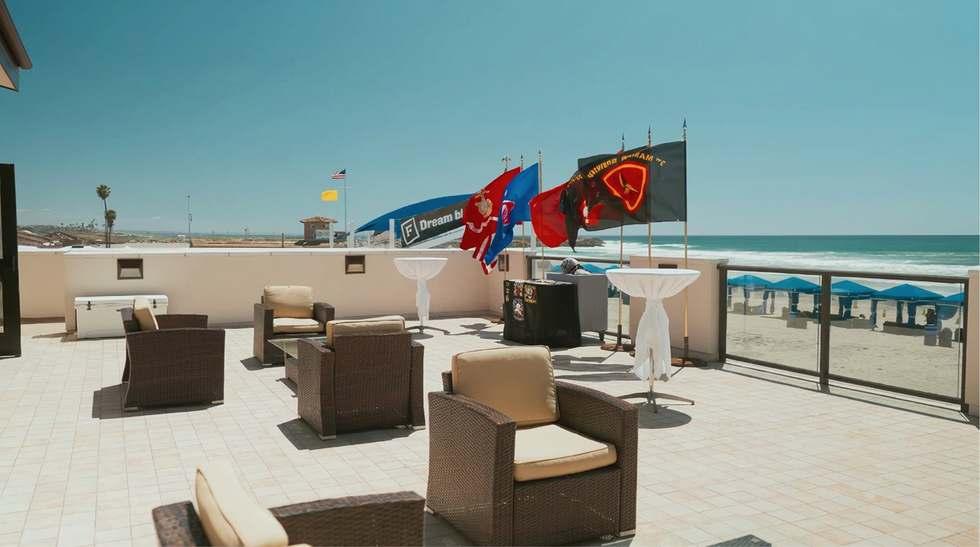
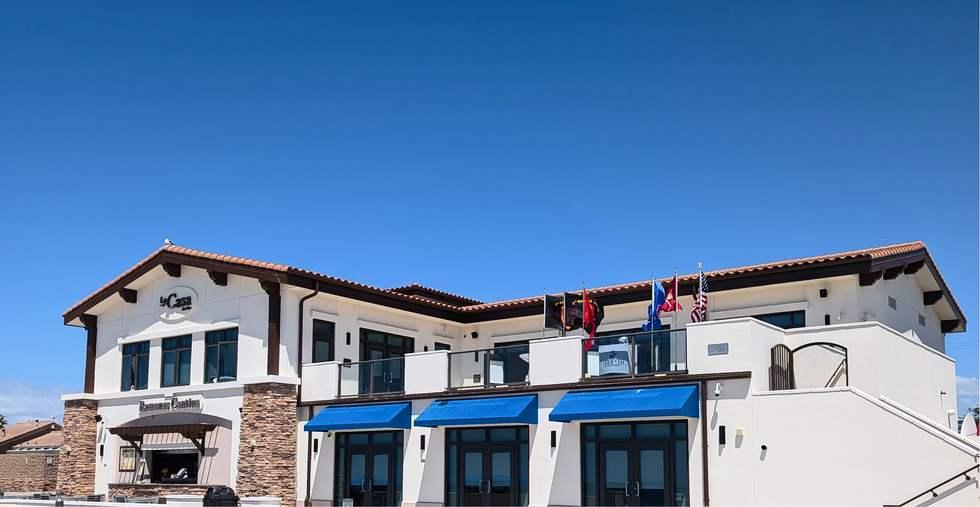
For Southern California groups that want the activity to become the holiday event, Experience Camp Pendleton provides a complete hosted option rather than a standalone game. The strongest team-building fits are Leatherneck, Devil Dog and Semper Fi.
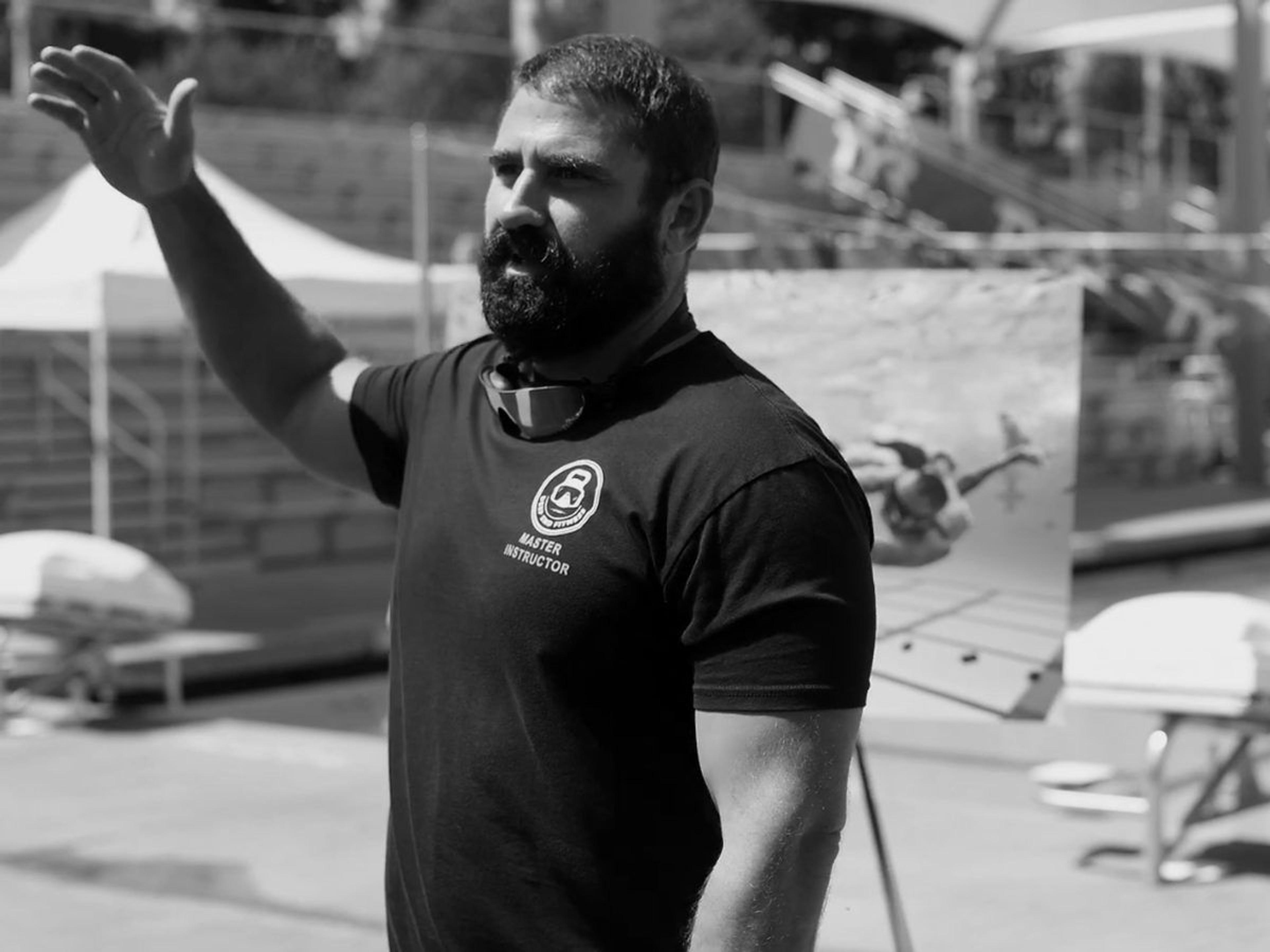
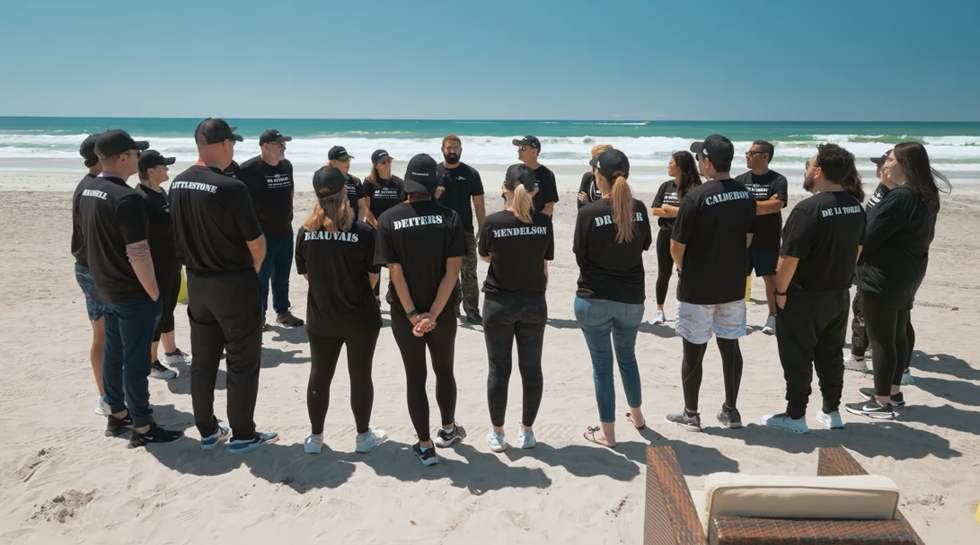
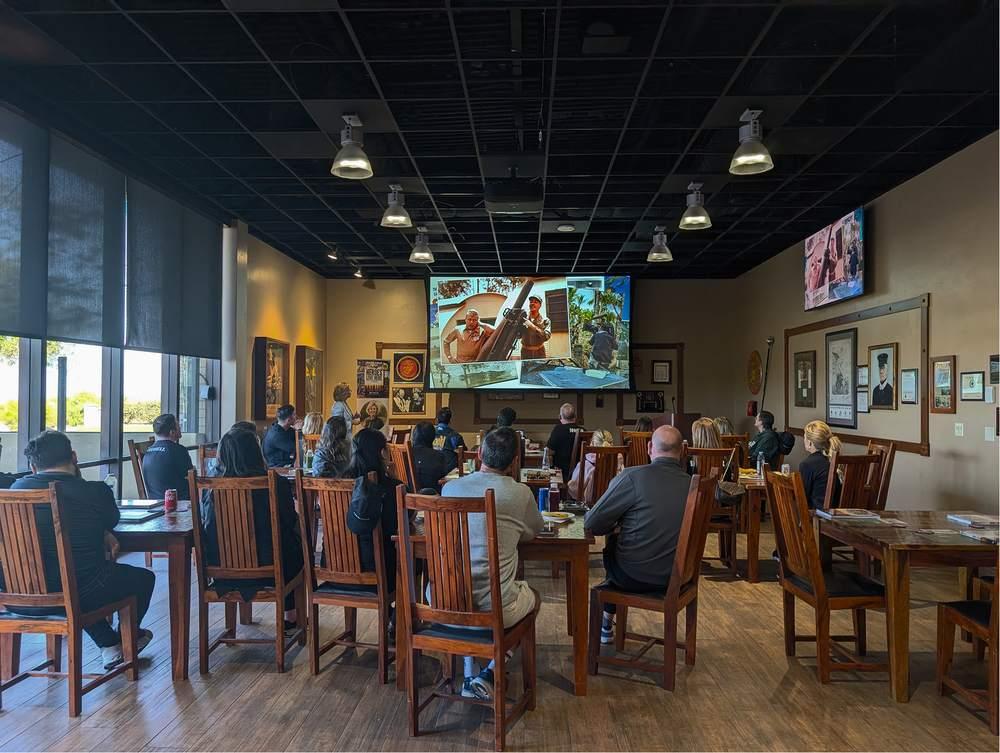
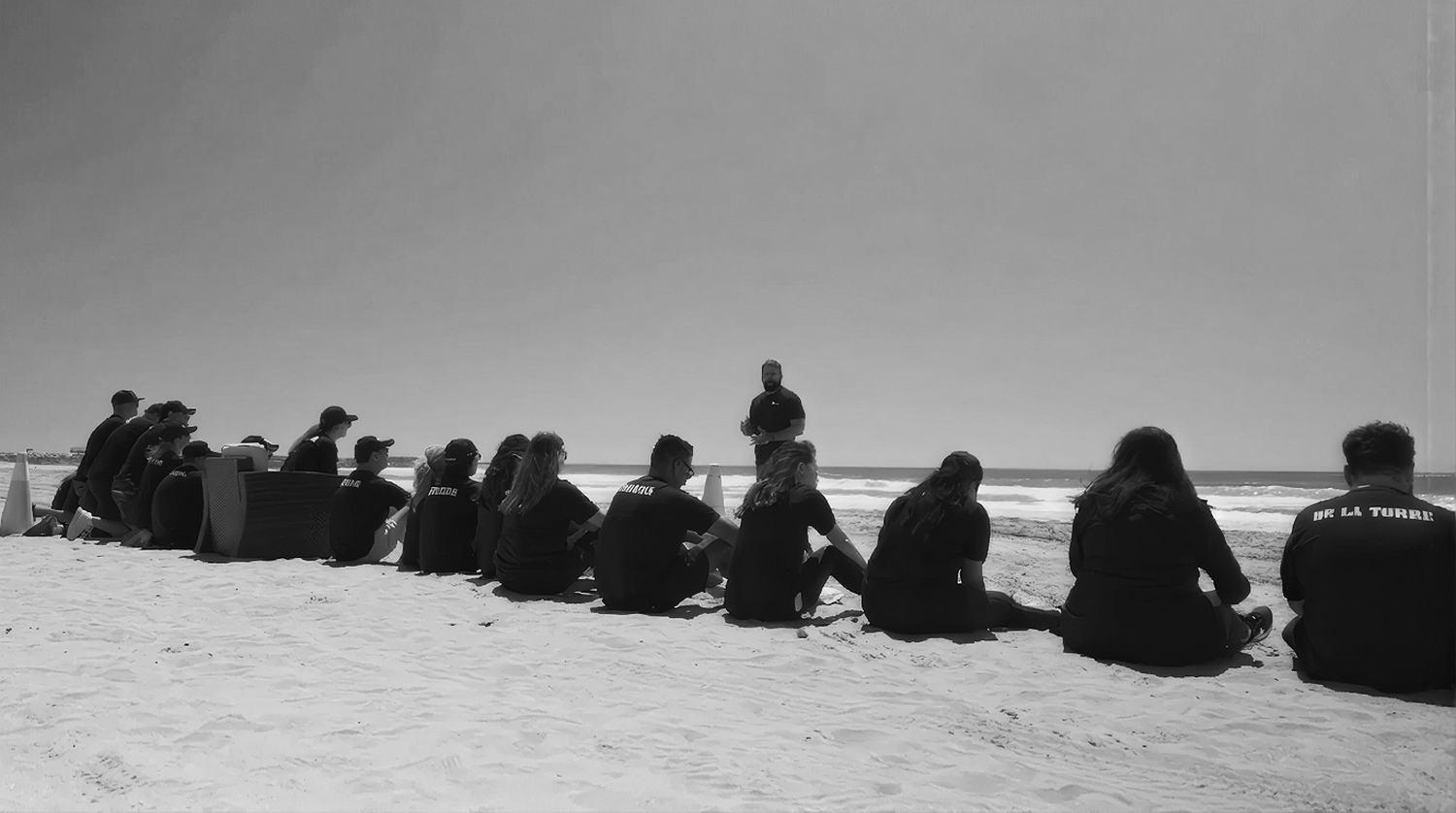
Leatherneck runs for four hours and includes a 90-minute beach session, history, a keynote and light snacks for groups up to 100. Devil Dog runs for five hours with a two-hour beach session, history and a sit-down lunch. Semper Fi uses eight hours for the complete arc: two venues, facilitated beach teamwork, history, lunch, keynote and a closing deck reception.
The exercises focus on communication and decisions under pressure. Physical elements scale to different fitness levels, and non-physical roles are built in; this is not a boot camp. The three-hour Recruit package is a strong history and keynote format for groups up to 50, but it does not include the beach session by default, so it is not the first choice when team building is the main purpose.
This option is not suitable when the group needs an entirely indoor event, cannot protect the travel time or cannot complete advance access planning. The installation controls entry, and coordinated transport, rosters and identification require lead time. Read the Camp Pendleton visitor-pass guide and compare the all-in offsite budget before committing travel.
Debrief: Which team behavior changed when the setting, time pressure or usual hierarchy changed?
How to choose for office, remote, hybrid and larger teams
For an office activity under 75 minutes
Choose the winter resource-allocation lab, appreciation network map or team-authored trivia. Each uses ordinary meeting space, creates a visible output and can finish without consuming the whole celebration.
For remote or hybrid teams
Choose the year-end rescue tabletop, skill-gift exchange or community microgrant pitch. Send the same packet to every participant, collect written input before discussion and appoint a facilitator who watches airtime. Do not make remote employees observe an in-room activity through one laptop.
For 50 to 100 people
Use parallel pods with identical materials and one common finish. The puzzle trail, service sprint and hosted Camp Pendleton formats can scale when station capacity, transitions and facilitation are designed before invitations. For more local options, compare San Diego team-building activities.
For mixed mobility or low physical demand
Choose the appreciation map, skill exchange, traditions gallery, trivia or microgrant pitch. If using an active or outdoor format, provide seated and non-physical roles that influence the result, an accessible route, shelter and an indoor backup.
When the activity is part of a full party
Protect the activity's start and finish rather than dropping it into an open reception. Seat people before instructions, keep the exercise shorter than the social time and leave a clean transition into food or recognition. Use the San Diego holiday-party venue guide when the setting is still undecided.
A ten-minute debrief that makes the activity useful
Keep the debrief short and separate observation from judgment.
- Ask each person to write one thing that helped the group and one moment of friction.
- Collect patterns without naming or ranking individuals.
- Ask where one pattern appears in everyday work.
- Choose one behavior the team can test for two weeks.
- Name an owner and a date to review what changed.
The activity creates a shared reference point. The small experiment is what turns it into team development. For a complete event workback, use the eight-week company-offsite playbook.
Experience Camp Pendleton is a commercial service operated by Urban Kitchen Hospitality / Mid Coast Supply Inc. It is not affiliated with, endorsed by or sponsored by the United States Department of Defense, the United States Marine Corps or Marine Corps Community Services. Access to Marine Corps Base Camp Pendleton is controlled by the installation and is subject to change. Confirm current requirements before travel.
Before you ask
Before you ask
Common questions
What are the best holiday team-building activities for work?
The best options match one useful behavior to the team's format. Use a rescue tabletop for handoffs, an appreciation map for recognition, a service sprint for shared purpose, a skill exchange for peer learning or a hosted offsite when the company wants the shared experience to anchor the event.
How long should a holiday team-building activity last?
Allow 45 to 90 minutes for a standalone office or remote activity, including instructions and a short debrief. A cooking or service activity usually needs two to three hours. A hosted offsite can take four to eight hours when the experience is the main event.
How do we make holiday team building inclusive?
Use culturally neutral framing, make personal or religious sharing optional, collect access and dietary needs privately, offer equivalent roles and explain whether attendance is optional. Avoid building the event around alcohol, public performance, gift exchange, physical speed or one religious tradition unless the group has explicitly chosen that format.
What works for a large group of 50 to 100 employees?
Use parallel pods, duplicate materials, visible timing and enough facilitators. Puzzle trails, service sprints, team-authored trivia and hosted multi-station experiences scale better than one activity that makes most people wait or watch.
What works for remote holiday team building?
Choose activities with equal digital inputs and a shared output, such as a rescue tabletop, resource-allocation lab, skill exchange, microgrant pitch or team-authored trivia. Keep breakout groups small, collect written input and give remote participants roles that shape the result.
Should holiday team building be competitive?
Competition is optional. If it helps the energy, score clarity, collaboration and adaptation rather than speed or performance. Use a shared finish for teams with low trust, strong hierarchy or accessibility differences.
Is Experience Camp Pendleton physically demanding?
No fixed fitness level is required. The facilitated beach exercises scale, and non-physical roles are built into the work. Recruit does not include the beach session by default; Leatherneck, Devil Dog and Semper Fi are the stronger team-building formats. Confirm the group's needs and current access process on the planning call.
Written by
Rene Diaz
President
Four packages
Bring your
team here.
Half a day to a full day, from a history session and lunch to both venues, beach team building and a reception on the deck.